Abstract
We often describe progress through the language of problems and solutions. We identify challenges, search for answers and measure success by our ability to resolve them. This way of thinking has become deeply embedded in design, engineering, business and everyday life, to the point where it appears almost self-evident.
Yet biology rarely describes living systems in these terms. Across evolutionary theory, ecology and systems science, organisms are not portrayed as entities that first recognize problems before generating solutions. Instead, they continuously interact with changing environments through variation, feedback, adaptation and selection. What appears to us as a successful solution may simply be one temporary expression within an ongoing process of adjustment.
This Research Note investigates whether problem solving is a meaningful biological concept or primarily a human interpretation of how living systems respond to change. Rather than asking how organisms solve problems, it asks whether the language of problems and solutions accurately reflects the way life organizes itself.
The investigation begins with a simple question that gradually becomes more difficult the longer it is observed.
The Question
Do living systems actually solve problems?
The question appears surprisingly ordinary. Almost every discipline concerned with innovation is built around the idea of problem solving. Designers solve problems. Engineers solve problems. Scientists solve problems. Organizations solve problems. The assumption is so familiar that it is rarely questioned. Yet when we begin observing living systems, another description gradually emerges. Biology speaks about adaptation, variation, ecological interactions and evolutionary change. It rarely suggests that organisms identify a problem before producing a corresponding solution.
- A tree does not decide how to solve drought.
- A coral reef does not formulate a strategy before responding to warmer oceans.
- A population does not collectively search for an answer.
Instead, living systems continuously respond to changing conditions. Some responses persist. Others disappear. Over time, these countless interactions create the appearance of intelligent adaptation without requiring the existence of a predefined problem or a final solution. Perhaps the question is not whether life solves problems. Perhaps the question is whether problem solving is the language humans use to describe processes that biology explains differently.
First Observations
Observation often begins by questioning language.
At first, the distinction between adaptation and problem solving may appear insignificant. Both seem to describe the same outcome: an organism continues to survive despite changing conditions.
Closer observation, however, reveals an important difference.
Problem solving implies that a problem exists first and that an appropriate solution follows. Adaptation describes no such sequence. It is not directed toward a predefined objective but emerges continuously through interactions between organisms and their environments.
Nothing in these processes suggests a final answer.
- Cells communicate.
- Materials reorganize.
- Populations diversify.
- Environmental pressures shift.
Living systems do not pause in order to solve change. They remain in constant dialogue with it. The longer this distinction is observed, the more it appears that biology describes responsiveness rather than resolution.
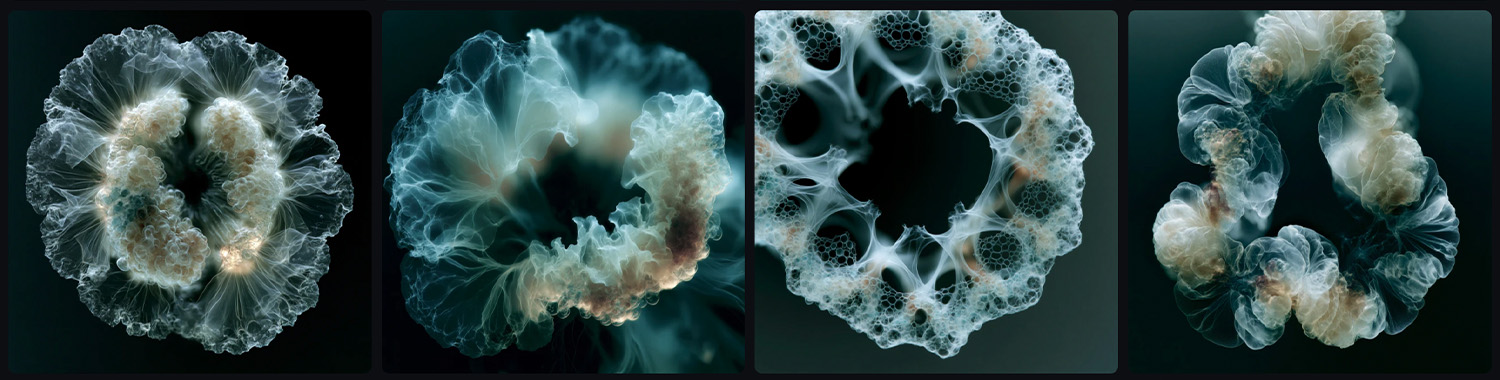
Looking Closer
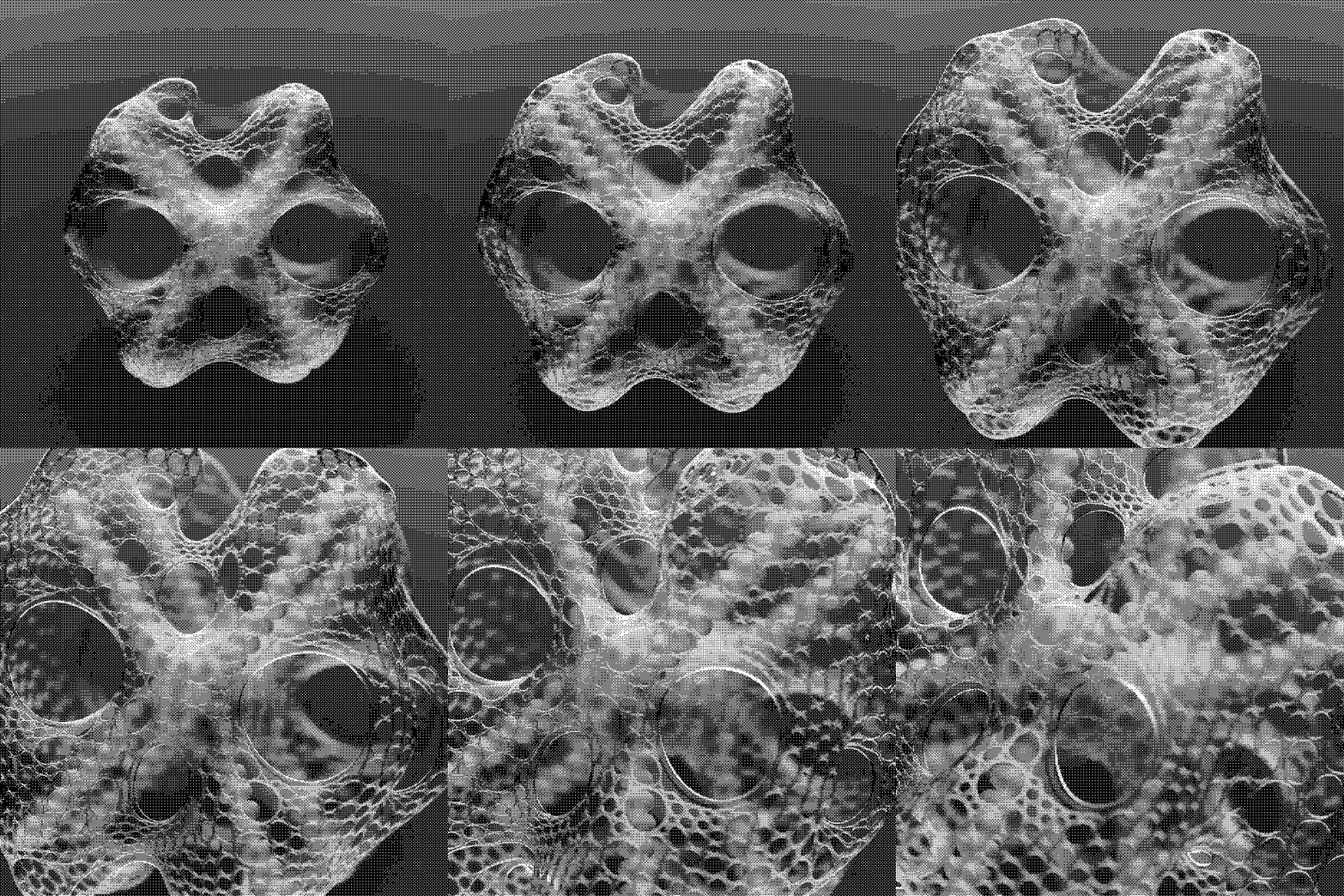
Observation becomes increasingly difficult once familiar concepts begin to dissolve. The idea of problem solving assumes stability. A problem exists, a solution is found and the process concludes. Living systems rarely operate within such fixed boundaries. Every adaptation alters the conditions from which future adaptations emerge. Every environmental change reshapes the context in which organisms continue to exist. Relationships evolve continuously, making every present state temporary rather than permanent. From this perspective, adaptation no longer appears as the outcome of successful problem solving. It becomes the continuous expression of an unfinished process. There is no final equilibrium. No ultimate optimization. No moment at which life reaches completion. Instead, biological systems remain capable of responding because they never stop changing. Perhaps this ongoing responsiveness represents a fundamentally different form of intelligence than the one implied by problems and solutions.
Research Observations
Biological resilience appears to depend less on finding the right answer than on maintaining the capacity to respond as conditions continue to change.
Observation 01
Living systems do not appear to distinguish between problems and normal conditions. Change is not treated as an interruption but as a constant characteristic of existence.
Observation 02
Adaptation emerges through continuous interactions between organisms and their environments rather than through predefined solutions to isolated challenges.
Observation 03
Biological resilience appears to depend less on finding the right answer than on maintaining the capacity to respond as conditions continue to change.
Biological Context
Evolutionary biology describes life as a continuous process of interaction between organisms and their environments. Rather than progressing toward predefined goals, populations change through variation, natural selection, ecological feedback and historical contingency. Every generation inherits the consequences of previous adaptations while simultaneously responding to new environmental conditions. In this context, biological success is never absolute but always relative to a particular moment, habitat and set of relationships.
This perspective leaves surprisingly little room for the concept of problem solving. Scientific literature more commonly refers to adaptation, fitness, developmental plasticity and resilience. These concepts describe dynamic processes rather than fixed objectives. An organism does not succeed because it has discovered the optimal solution, but because it remains sufficiently responsive within an environment that never stops changing.
Seen through this lens, adaptation becomes less about resolving individual challenges and more about preserving the capacity for continued adjustment. Life persists not because it reaches stability, but because it remains capable of reorganizing itself as stability continually shifts.
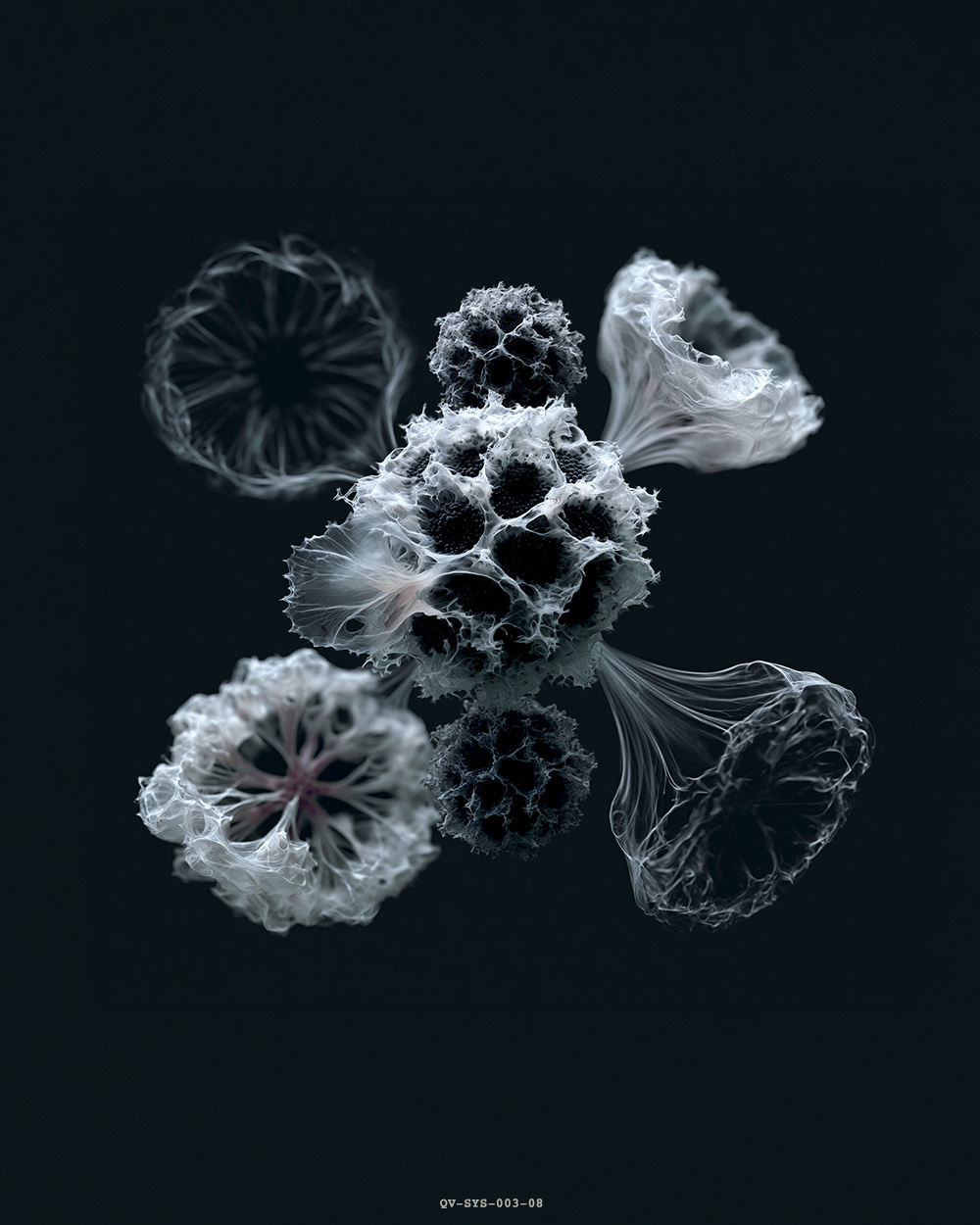
“Perhaps living systems do not solve problems. Perhaps they simply never stop adapting.”
Reflection
The distinction between adaptation and problem solving may seem subtle, yet it carries profound implications for the way we design products, organizations and technologies. Much of human innovation begins by defining a problem before searching for a corresponding solution. Living systems suggest another possibility. They rarely separate the two. Instead, they remain in continuous dialogue with their surroundings, adjusting through countless interactions that collectively shape future behavior.
This Research Note does not argue that problems do not exist, nor that problem solving has no value. Rather, it asks whether this language accurately reflects the processes we observe in biology. Perhaps what we describe as a solution is often only a temporary state within an ongoing process of adaptation. If so, one of the most familiar concepts in design may deserve to be reconsidered, not because it is incorrect, but because living systems may be describing the world in a fundamentally different way.
“What if adaptation is not the solution to a problem, but the process through which life continues?”
Continue the Research
This investigation is not intended as a conclusion. It represents another step within a broader effort to understand how living systems organize themselves and how their principles might challenge the assumptions embedded in human thinking.
If biology rarely speaks in terms of problems and solutions, new questions inevitably arise. Which concepts that dominate design, management and innovation are similarly rooted in human interpretation? Which alternative perspectives become visible once we begin describing living systems in their own language rather than our own?
Every Research Note published by QQUUEERRYY contributes to this growing investigation. Each study revisits familiar concepts, questions established assumptions and expands an evolving archive exploring the organizational principles of life.
Further Questions
- Is problem solving a biological process or a human interpretation of adaptation?
- How does continuous responsiveness differ from searching for solutions?
- Which concepts in design are shaped more by human language than by biological reality?
- Can organizations become more resilient by designing for adaptation rather than optimization?
- What changes when we replace the language of problems and solutions with the language of relationships and feedback?
References
- Humberto R. Maturana & Francisco J. Varela
The Tree of Knowledge: The Biological Roots of Human Understanding - Ludwig von Bertalanffy
General System Theory - Stafford Beer
Brain of the Firm - Donella H. Meadows
Thinking in Systems: A Primer - James Gleick
Chaos: Making a New Science - Fritjof Capra & Pier Luigi Luisi
The Systems View of Life
Suggested Reading
- Humberto R. Maturana & Francisco J. Varela - The Tree of Knowledge
- Ludwig von Bertalanffy - General System Theory
- Donella H. Meadows - Thinking in Systems
Research Information
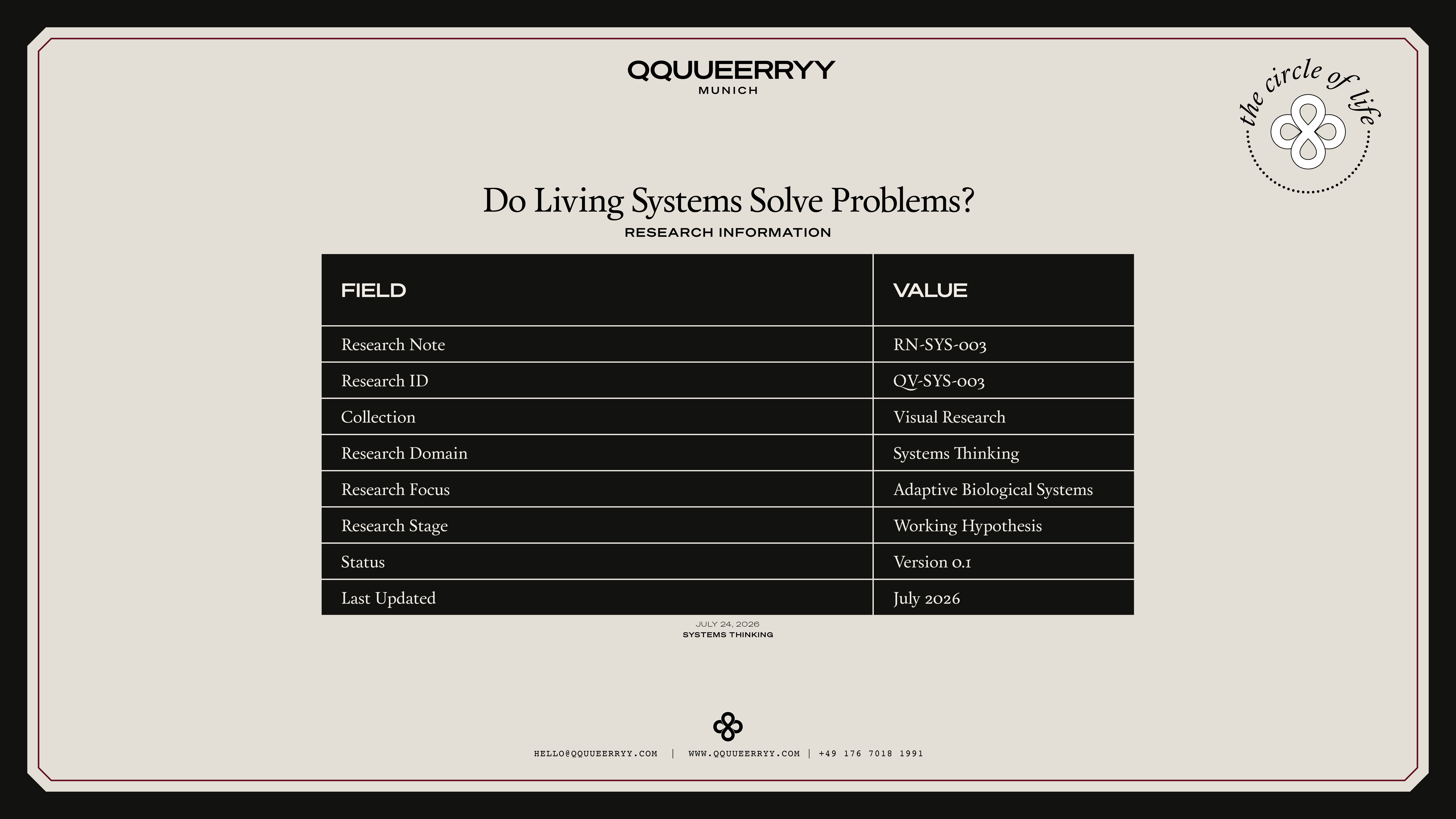
Method Statement: QQUUEERRYY is grounded in an iterative research methodology combining biological inquiry, scientific literature, systems thinking, observation, writing, curation and visual communication. This visual was developed within this research process and may incorporate generative artificial intelligence as one of several tools used to support exploration, visualization and communication.
Every answer creates another question. The investigation continues.