Abstract
We often describe new beginnings as moments of separation. One chapter ends before another begins. Old structures are removed to make space for new ones. Change becomes a sequence of distinct states: before and after, old and new, ending and beginning.
Living systems suggest a more complex picture. Biological transformation frequently involves processes that overlap rather than follow one another cleanly. Existing structures can be dismantled while new ones are already forming. Cells can change their state or function. Old tissue can be removed and replaced as part of one coordinated process. During metamorphosis, some structures disappear while others persist, reorganize or emerge. What appears to us as a new beginning may therefore contain far more continuity than the idea of starting over suggests.
This Research Note asks whether something truly needs to end before something new can begin — or whether transformation often happens through the simultaneous processes of preserving, dismantling and becoming.
The Question
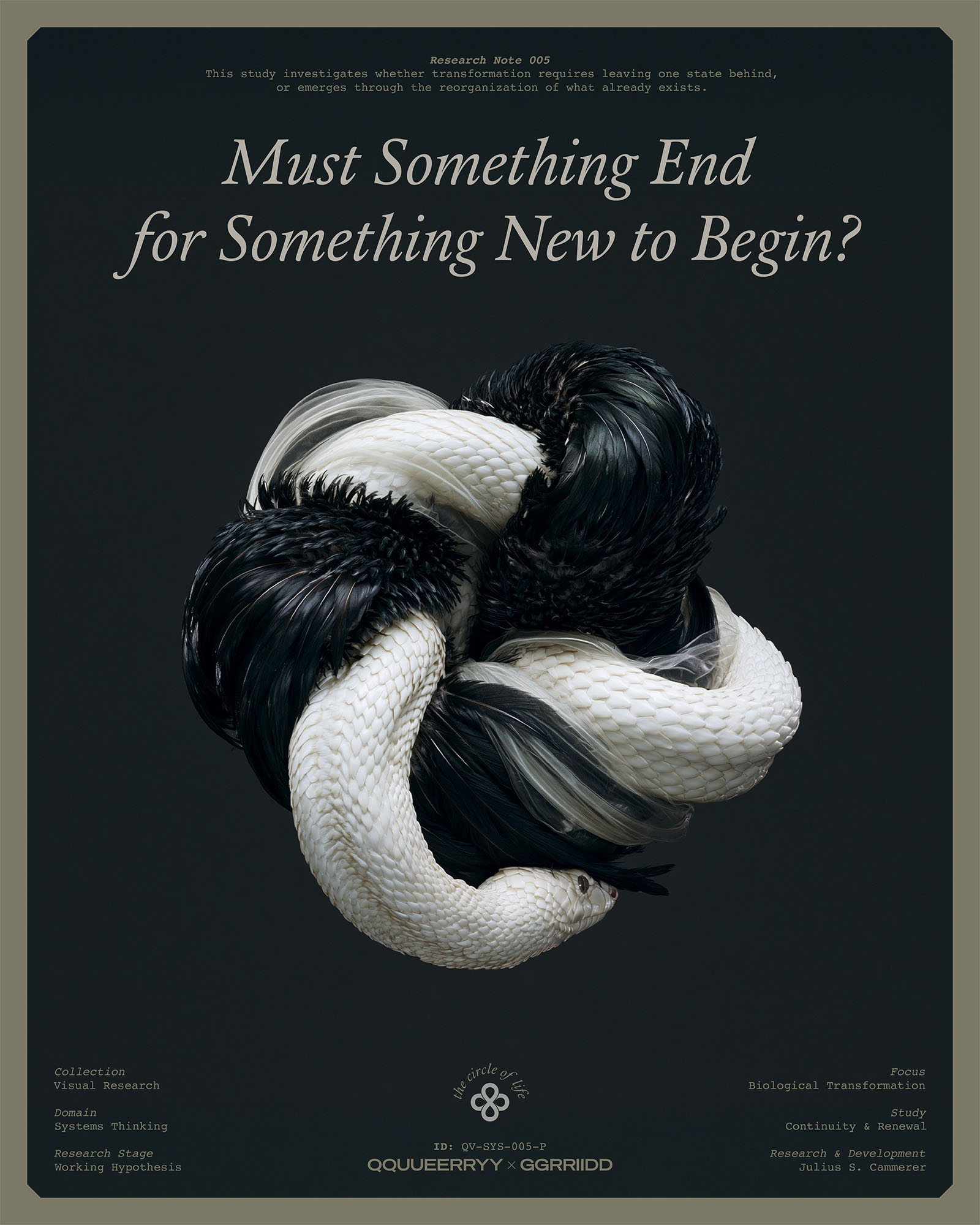
Must Something End for Something New to Begin?
Human narratives often divide change into chapters. We finish one thing and begin another. We leave something behind in order to move forward. This language creates clear boundaries between what was and what will be.
But where exactly is that boundary in a living system?
A body is continuously renewing itself while remaining the same body. Bone is removed and rebuilt throughout life. During tissue repair, mature cells can alter their state and participate in regeneration. In complete insect metamorphosis, some larval tissues are eliminated, others are extensively remodelled, and new adult structures develop from cells already present within the organism.

First Observations
Before the Old Is Gone
A snake periodically sheds the outer layers of its epidermis. From the outside, ecdysis can appear like a remarkably clear transition: an old surface is discarded and another takes its place. But the organism itself does not begin again. The shedding is one event within an ongoing biological process of growth, maintenance and renewal. Snake ecdysis serves functions including growth and restoration of properties involved in protection and physiological exchange.
This gives us a useful first distinction. Renewal does not necessarily mean replacement of the system itself. Something can be left behind while continuity remains. The shed skin is evidence of a previous state, but the organism carries its development forward.
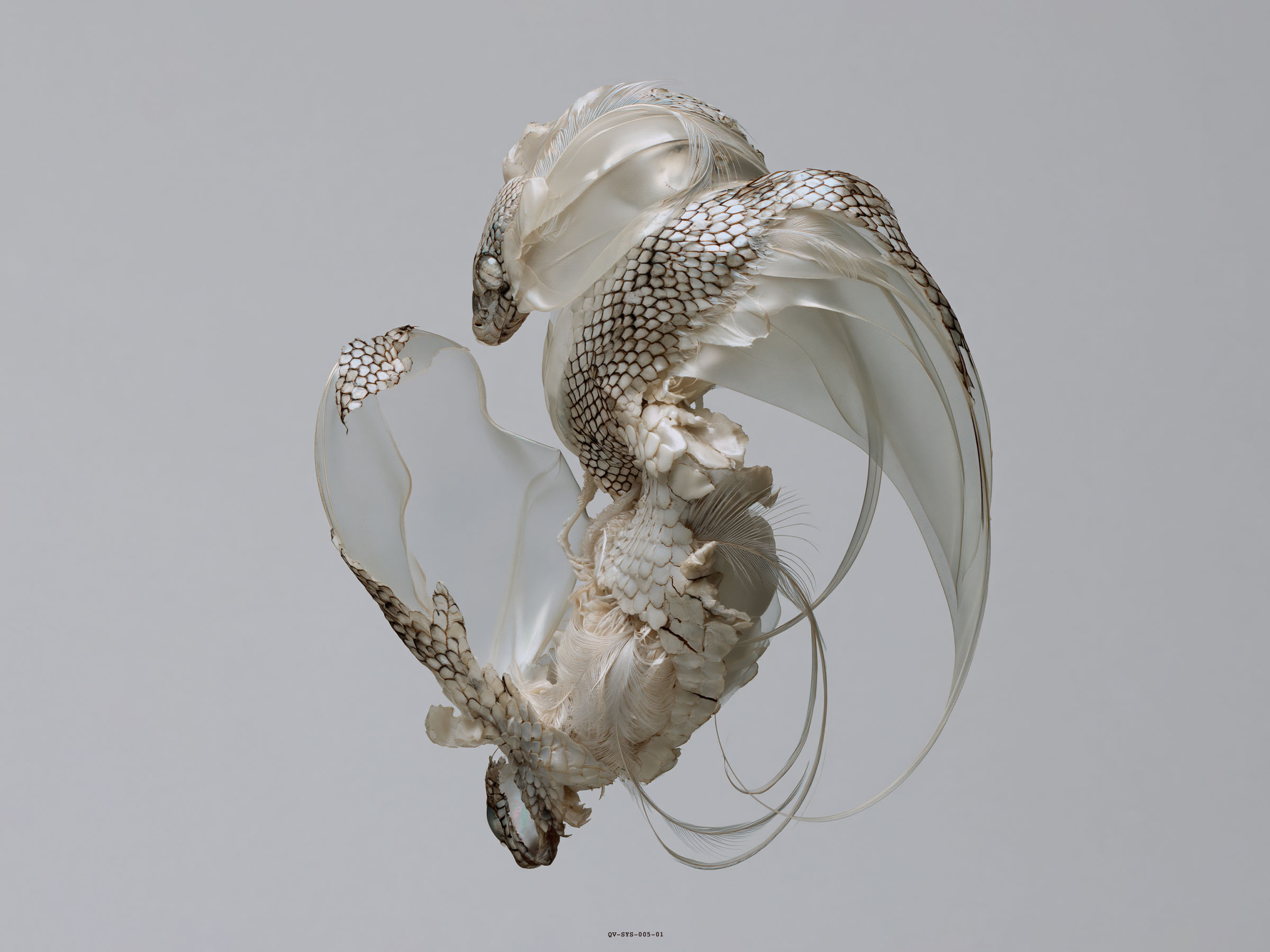
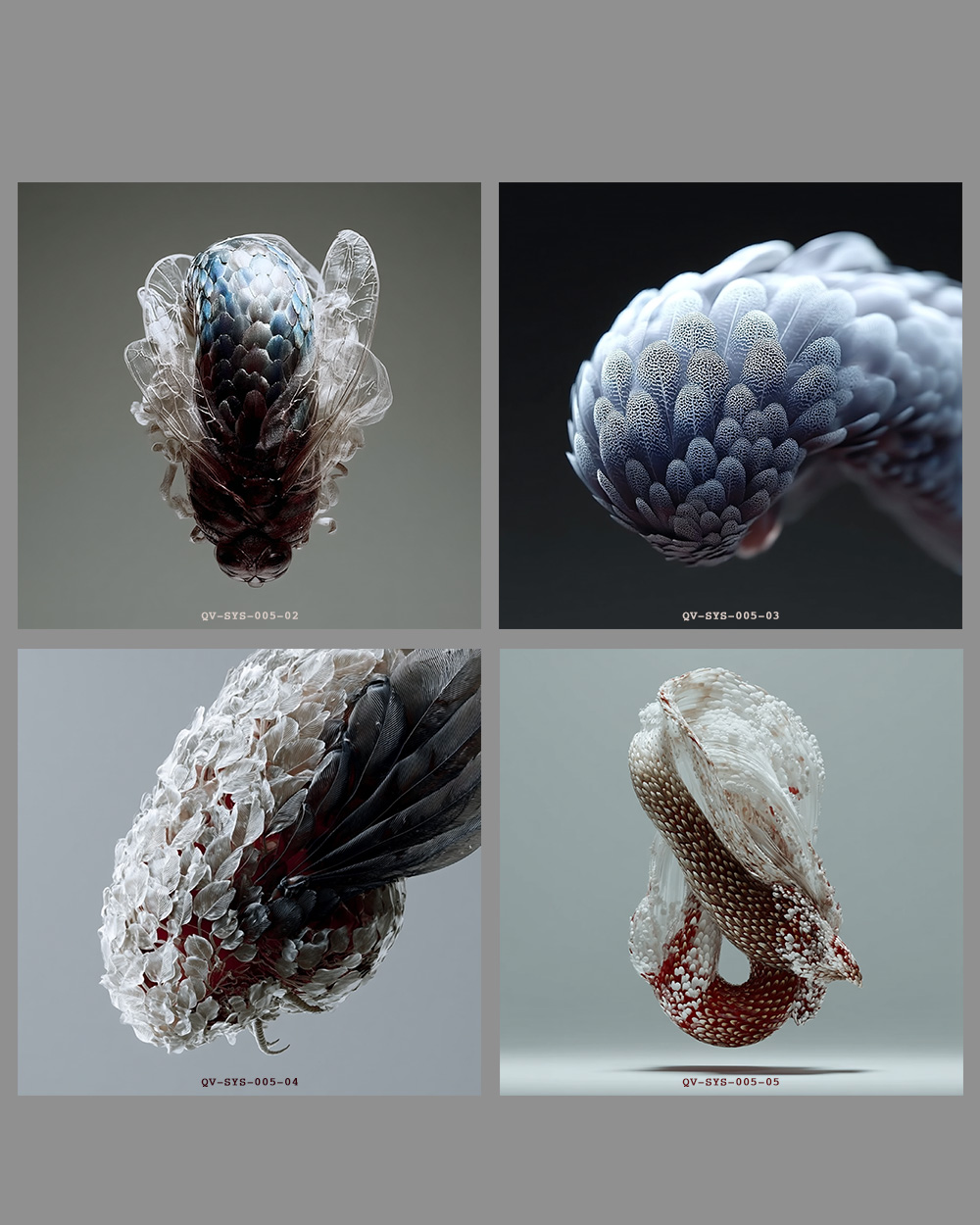
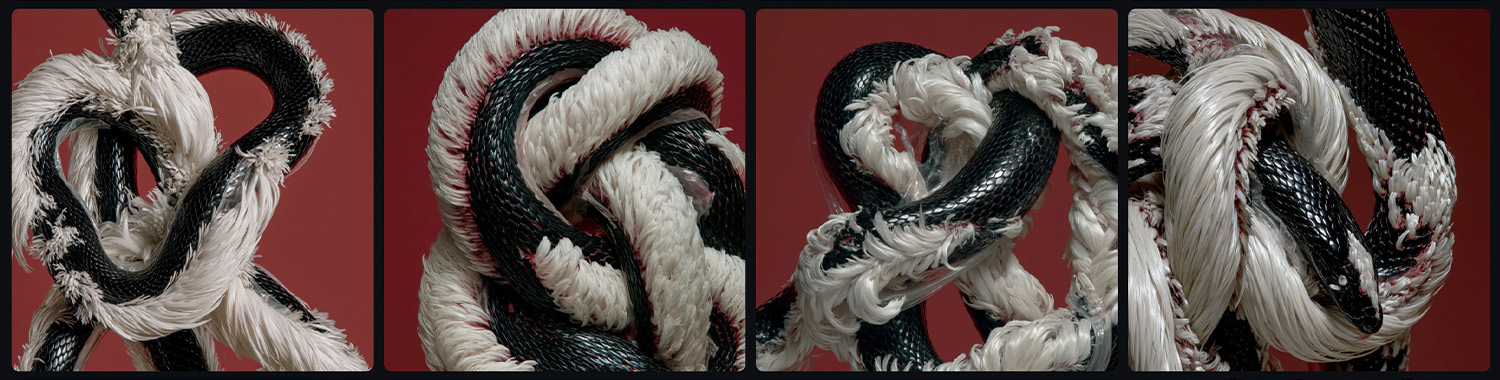
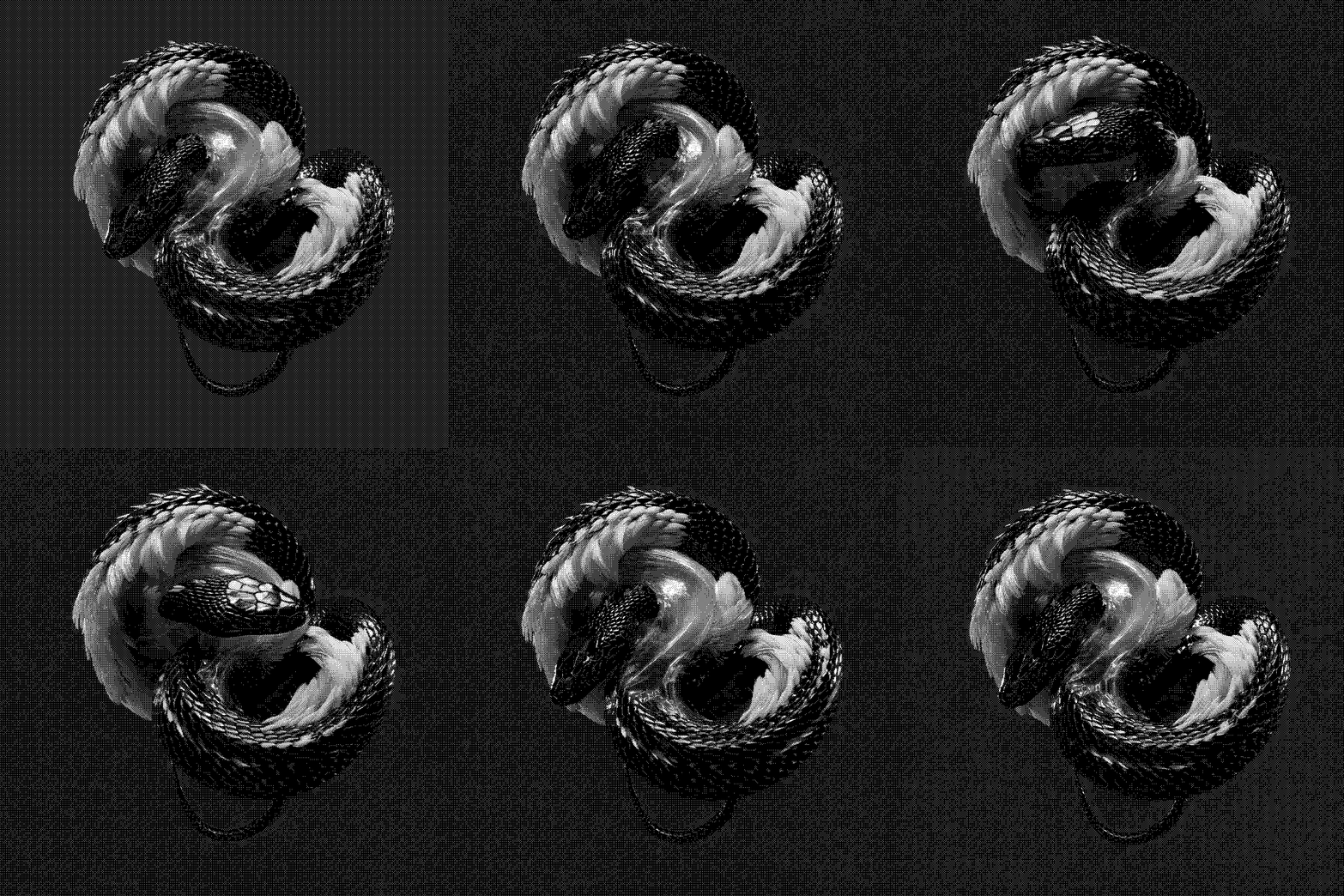
Our visual study deliberately exaggerates this idea. Scales and feathers — structures that would not naturally coexist in this form — become intertwined within a speculative organism. The image is not intended as biological documentation. It asks instead whether we can imagine transformation without drawing a clear line between the state that existed before and the one emerging next.
Looking Closer
Transformation Is Not a Single Process
The closer we look, the harder it becomes to describe biological transformation through a simple sequence of old → ending → new.
Complete insect metamorphosis provides an extreme example. During the transition from larva to adult, different tissues experience very different fates. Some larval organs degenerate through programmed cell death. Others are remodelled without being completely replaced. Elsewhere, undifferentiated cells proliferate and differentiate to form adult structures such as wings and legs. Destruction, persistence, reorganization and formation can therefore occur within the same developmental transformation.
Even the materials involved do not simply become irrelevant. Autophagic processes can contribute to breaking down cellular components and recycling their material during metamorphic transformation.
Something may end without everything beginning again.
Research Observations
Across the examples examined, transformation rarely appears as a clean transition between two isolated states. Living systems may preserve structures, dismantle them, reorganize them or alter the state of existing cells. What connects these processes is not the absence of endings, but the absence of a necessary biological zero point.
Observation 01
Transformation does not require starting from zero.
Living systems can generate new states from structures, materials and information that already exist. What came before may remain active within the process of becoming.
Observation 02
The existing system can participate in producing its next state.
Cells can change their identity or function, tissues can be remodelled, and existing biological structures can contribute directly to regeneration and renewal.
Observation 03
Preservation, loss and emergence can occur simultaneously.
Transformation does not always follow a sequence in which one state must disappear before another can begin. Different processes of removal, persistence and formation can overlap within the same living system.
The new does not always replace the old. It can emerge through its reorganization.
Biological Context
Continuity Through Change
Bone offers an especially tangible example because it appears permanent while being biologically dynamic. Throughout life, skeletal tissue undergoes continuous remodelling. Osteoclasts resorb old or damaged mineralized bone, while osteoblasts subsequently form new bone. These processes are tightly coupled and occur asynchronously at many locations throughout the skeleton. The persistence of the skeleton therefore depends partly on continuous localized destruction and reconstruction.
Metamorphosis demonstrates a more radical form of transformation. Some tissues disappear, some persist and are reshaped, while others emerge through proliferation and differentiation. Tissue repair adds another mechanism: cells themselves can display plasticity and participate in rebuilding damaged structures. None of these processes should be treated as biologically identical, but together they reveal something important: continuity and transformation are not necessarily opposites.
A living system can remain recognizable precisely because its components are capable of changing.

“What if the new does not begin after the old has disappeared, but develops within a system already undergoing change?”
Reflection
We often evaluate change through direction.
Moving forward suggests progress. Returning suggests regression. Starting again can imply that what came before failed. A new state is expected to justify itself by being more successful, more efficient, more advanced or somehow better than the previous one. Biology does not remove the consequences of change. Transformation can involve loss. Structures disappear. Cells die. Functions can be abandoned. Not every transformation is beneficial, and not every new state represents improvement. But this is precisely what makes the observation interesting.
Transformation does not inherently describe progress. It describes change.
Perhaps the assumption worth questioning is therefore not whether endings exist. They clearly do. It is whether every meaningful transformation requires us to divide experience into what must be left behind and what may begin afterwards. If living systems can preserve, dismantle and reorganize simultaneously, perhaps beginning and ending are not always opposite moments. Perhaps they are sometimes different parts of the same process.

Continue the Research
Every Research Note documents the current state of an ongoing investigation. It is not intended as a final answer, but as an invitation to continue asking better questions. RN 005 began with the idea of a new beginning. It developed into a broader investigation of transformation, continuity and the boundaries we place between one state and another. The investigation remains open.
Further Questions
- Can something become new without becoming something else entirely?
- How much of a previous state remains within the next?
- When does renewal require destruction?
- What determines which structures are preserved, remodelled or removed?
- Can continuity depend on continuous change?
- Does becoming different require becoming better?
- Can there be a setback without a predefined idea of forward?
- What if change does not need to justify itself as progress?
References
- Brown, Jeffrey W.; Cho, Charles J.; Mills, Jason C.
Paligenosis: Cellular Remodeling During Tissue Repair. Annual Review of Physiology, 2022. - Tettamanti, Gianluca; Casartelli, Morena
Cell Death During Complete Metamorphosis. Philosophical Transactions of the Royal Society B, 2019. - Kenkre, J. S.; Bassett, J. H. D.
The Bone Remodelling Cycle. Annals of Clinical Biochemistry, 2018. - Hadjidakis, Dimitrios J.; Androulakis, Ioannis I.
Bone Remodeling. Annals of the New York Academy of Sciences, 2006. - Nicolson et al.
Ecdysone Controlled Cell and Tissue Deletion. Cell Death & Differentiation, 2020. - Lillywhite, Harvey B.; Jacobson, Elliott R.; Sheehy III, Coleman M.
Complexity in the Timing of the First Postnatal Ecdysis in Snakes. Journal of Experimental Biology, 2024.
Suggested Reading
- Paligenosis: Cellular Remodeling During Tissue Repair - Brown, Cho & Mills. A useful introduction to how mature cells can change state during tissue repair and regeneration.
- Cell Death During Complete Metamorphosis - Tettamanti & Casartelli. Particularly relevant for understanding why metamorphosis is not simply replacement, but a combination of deletion, remodelling and formation.
- The Bone Remodelling Cycle - Kenkre & Bassett. A strong example of how biological continuity can depend on coordinated removal and reconstruction.
- Thinking in Systems - Donella H. Meadows. Not a biological account of metamorphosis or regeneration, but valuable for considering change, feedback, persistence and system behaviour beyond isolated events.
Research Information

Method Statement: QQUUEERRYY is grounded in an iterative research methodology combining biological inquiry, scientific literature, systems thinking, observation, writing, curation and visual communication. This visual was developed within this research process and may incorporate generative artificial intelligence as one of several tools used to support exploration, visualization and communication.
Every answer creates another question. The investigation continues.